Lowest payment
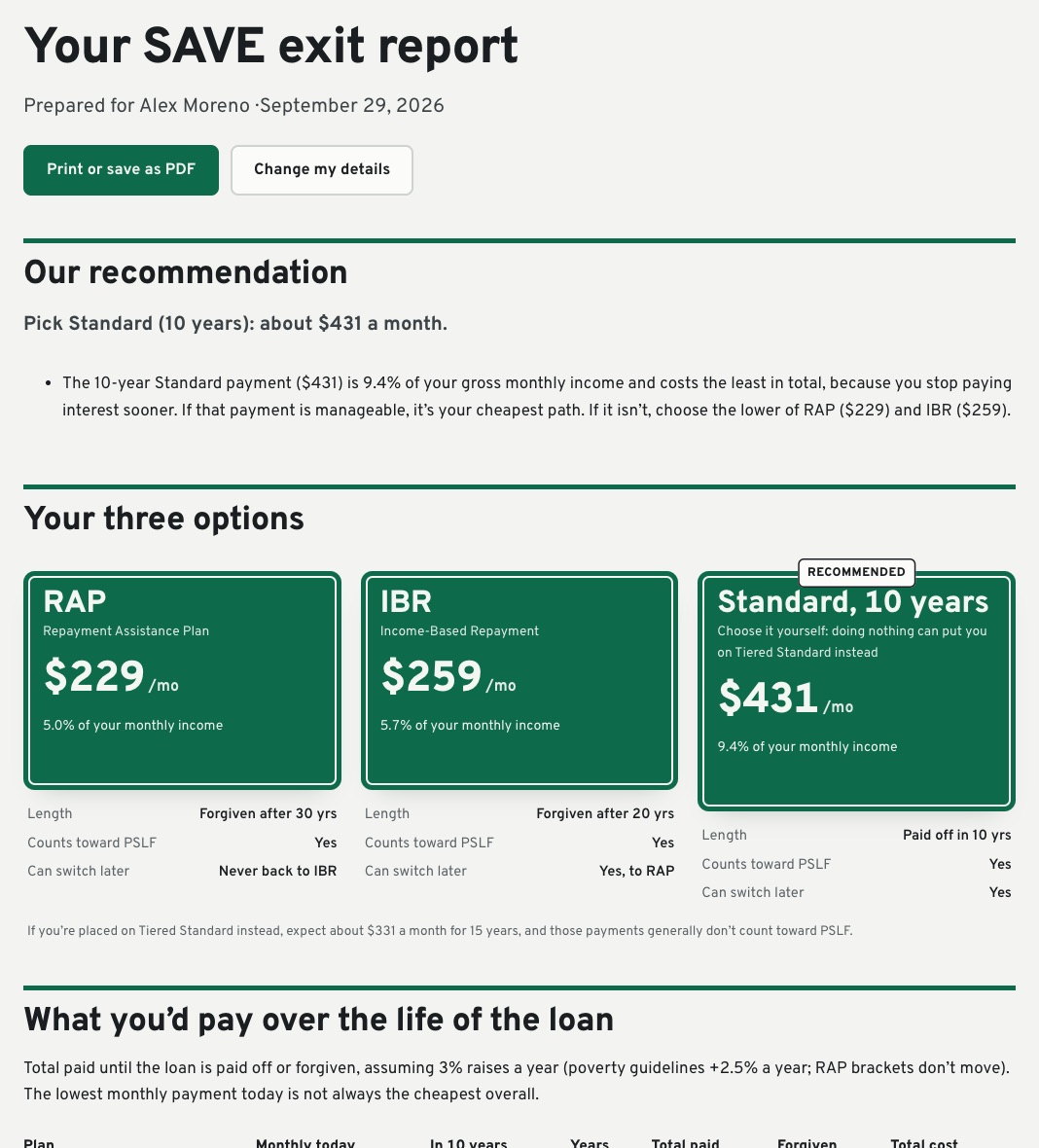
RAP
Repayment Assistance Plan
/mo
5.0% of your monthly income
- Length
- Forgiven after 30 yrs
- Counts toward PSLF
- Yes
- Can switch later
- Never back to IBR
- Deadline to choose
- Open any time
For many couples it’s the biggest saving on the way out of SAVE, and the one fewest people calculate.
Short version: on both RAP and IBR, filing your taxes separately leaves your spouse’s income out and can cut your payment a lot. In exchange, filing separately usually costs more in taxes. The right call comes from comparing the two numbers.1
Fictional couple: $120,000 joint AGI, $45,000 of it earned by the borrower; one child; $60,000 owed at 6.5%; the spouse has no federal loans.
Filing separately can raise the household’s tax and rules out some breaks. For example, you can’t take the student loan interest deduction (up to $2,500) if you file as married filing separately.2 In community-property states the rules for splitting income are different. Before you decide, ask a tax preparer for the tax difference and compare it with the payment savings.
If you file jointly and both have federal loans, the household payment is calculated on the joint AGI and split by what each of you owes. Our calculator does this when you enter your spouse’s balance.
Choose "Married filing jointly" and enter your own AGI: you’ll see how much filing separately could save you.
Showing an example borrower: $55,000 income, single, $38,000 at 6.5%. Enter your numbers to see yours.
Lowest payment
Repayment Assistance Plan
/mo
5.0% of your monthly income
Lowest payment
Income-Based Repayment
/mo
5.7% of your monthly income
Lowest payment
Standard plan, assigned automatically
/mo
9.4% of your monthly income
Or $331/mo on Tiered Standard (15 yrs, no PSLF credit).
Estimates from the 2026 federal formulas. Your servicer calculates the official amount.
Your report tells you which plan to pick with your numbers, what to watch for, and the exact steps. Instant and printable.
$29 one time
Secure checkout by Stripe. Card, Apple Pay or Google Pay. 14-day money-back guarantee. If it doesn’t help, email us for a full refund.
$29 one time
Which plan to pick and why, what you’ll pay in total, whether filing separately saves you money, PSLF, the steps on studentaid.gov, and ready letters if your servicer gets it wrong.
See the report14-day money-back guarantee. Switching is free at studentaid.gov: we sell clarity, never the paperwork.